We are beginning to roll out StayClean in the hotel industry through initial trials. This new stage aims to develop the platform by taking into account the needs of hotels, the way they are organised and their teams’ day-to-day work.
In a hotel, preparing a room is part of a collective effort. Departures, ongoing stays, arrivals and unexpected events overlap throughout the day. Our approach is to start from this reality and explore developments that could help teams coordinate more effectively and contribute to the quality of the guest welcome.
Starting with the actual rhythm of a hotel
A room vacated in the morning may sometimes need to welcome a new guest just a few hours later. Another remains occupied and requires service tailored to the ongoing stay. Elsewhere, a departure is delayed or a piece of equipment needs to be checked before the room can be made available again.
These situations raise very practical questions: which rooms should take priority? What instructions need to be passed on? Who should be informed when room preparation falls behind? At what point does reception have information reliable enough to respond to the guest?
The answers depend on each hotel. Team size, the allocation of responsibilities, working hours and any use of external service providers all influence how work is organised. The initial trials are therefore intended to help us understand these differences and identify appropriate adaptations for StayClean.
Exploring features that support coordination
StayClean already offers tools for scheduling and tracking service tasks, as well as quality reports. This foundation informs our thinking about hotel use cases. Adapting it means taking into account how departments work together within the same hotel.
Several needs guide the possibilities we are exploring:
-
Distinguishing checkout tasks from those carried out during a stay.
-
Making priorities and instructions easier for the people concerned to understand.
-
Helping information flow between housekeeping teams, their supervisor and reception.
-
Making it easier to flag an item that needs checking or a difficulty encountered while preparing a room.
-
Clarifying inspection stages and responsibilities before a room is made available again.
These possibilities describe the adaptation work now underway. Their value needs to be assessed in practice, in light of each hotel’s constraints and feedback from its teams.
Taking everyone’s work into account
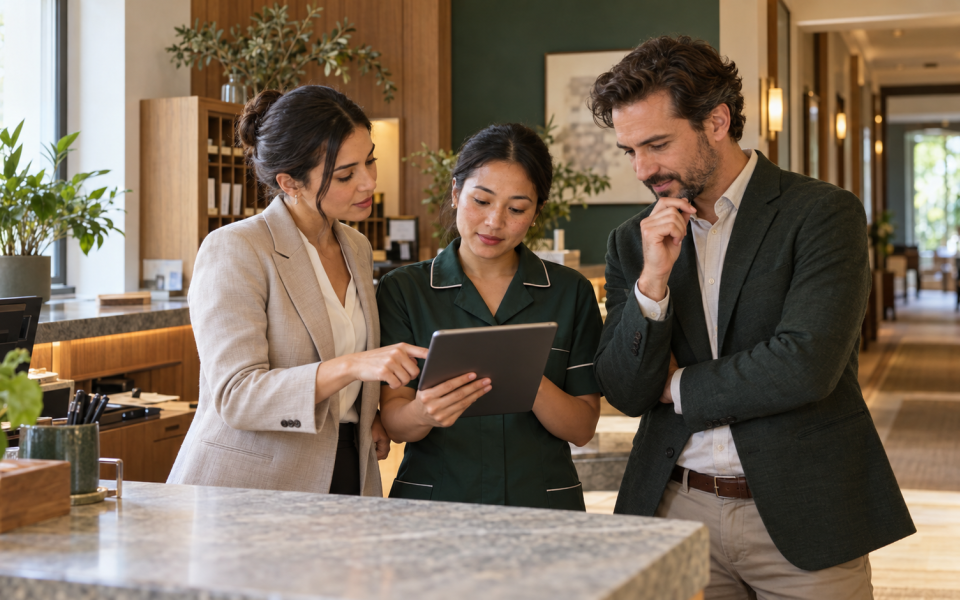
For someone responsible for cleaning rooms, useful information primarily concerns the tasks to complete, their order and any specific instructions. For a housekeeping supervisor, it may mean tracking progress, changing a priority or checking an issue that has been flagged. Reception, meanwhile, needs to know how preparation is progressing in order to organise arrivals.
Our goal is to explore an experience suited to these different roles. This means considering how clearly information is presented, how straightforward communication is and where the tool fits into an already busy day.
The way a difficulty is reported also deserves attention. An unclear instruction, a room that is still occupied or an item that needs checking must be understandable to the right person. Good coordination depends on these everyday details.
Moving forward gradually, guided by actual use
We approach this stage as a phase of experimentation and adaptation. Hotels have varied needs, and a feature that is relevant to one property may require adjustments at another.
The questions to examine are simple: is information accessible at the right moment? Do teams understand what is expected? Is a change in priority easy to follow? Does the handover remain clear when another person takes over the shift?
This approach should help us develop StayClean gradually, with features whose usefulness can be verified in the field. It gives an important place to existing working methods and the experience of professionals who know their hotel.
Connecting organisation with the guest experience
For the guest, this coordination is reflected in very tangible moments: clear information on arrival, a carefully prepared room, a request passed on properly during the stay. Behind the scenes, several people contribute to this continuity of service.
It is this connection that we want to work on through these initial hotel trials. Developing StayClean, understanding hotels’ constraints and building an experience that is useful to their teams are the guiding aims of this new stage.