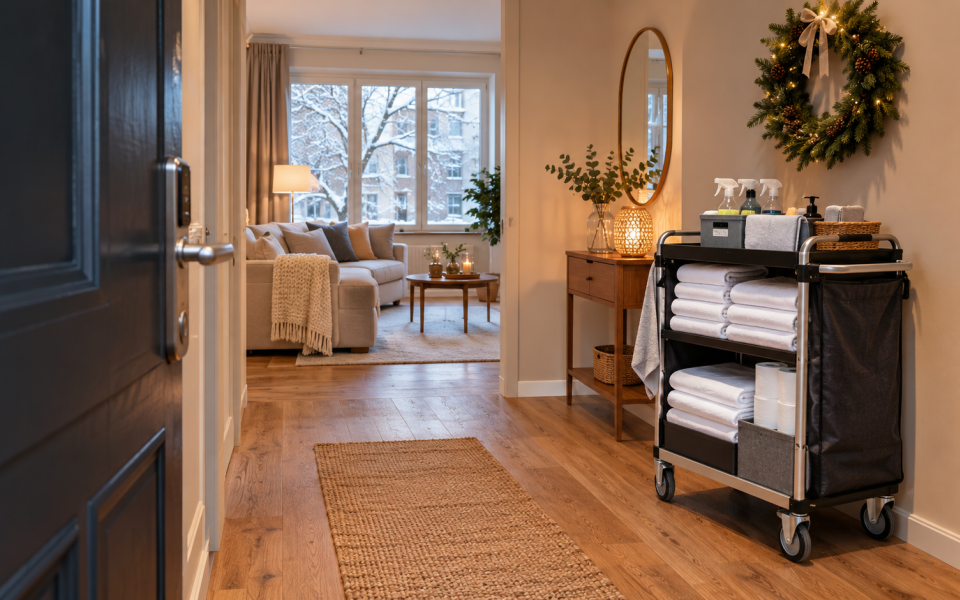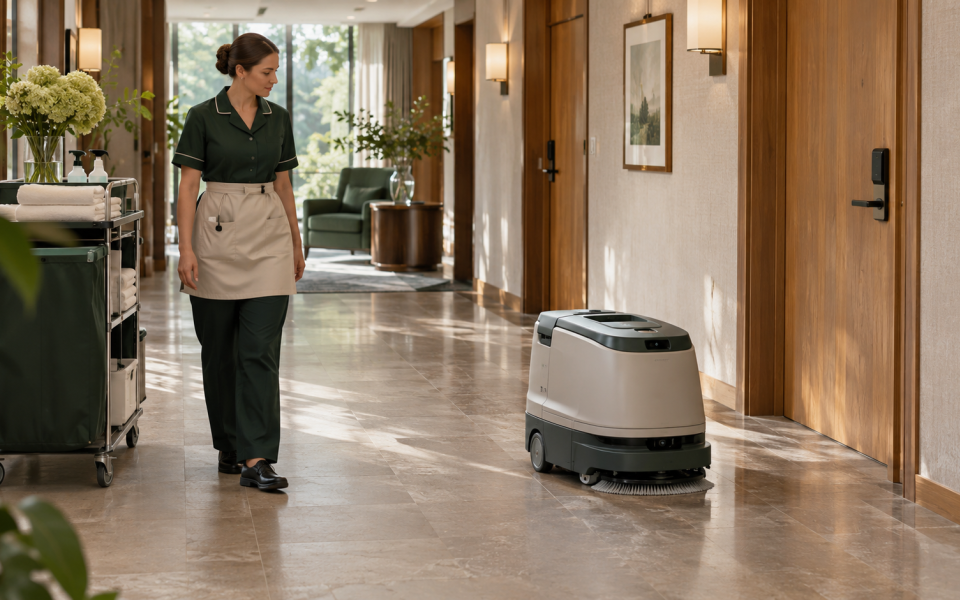

Guests do not discover their accommodation only when they open the door. They follow a street, look for an entrance and sometimes cross a courtyard or shared staircase. Those few minutes can influence their assessment of the stay. For a property management service, they raise a very practical question: what can you correct directly, what should you report, and what can you only explain?
On 1 November 2026, Guyana’s Department of Public Information reported on the launch of Tourism Awareness Month in Georgetown. The message presented connects the quality of the welcome with accommodation, transport, residents’ hospitality and the condition of public spaces. This reminder extends beyond a single destination: a tourism experience involves several parties. It does not, however, transfer all their responsibilities to the accommodation manager. Source: DPI Guyana, 1 November 2026.
Define three simple areas of responsibility
Here is an organisational method to adapt to contracts and locations. The first area is the accommodation and its private outdoor or ancillary spaces. The second covers shared areas: a communal entrance, landing, shared room or internal access route. The third concerns public space and external services.
For each one, record who can decide on an intervention, who can carry it out and who receives reports. A private terrace and the pavement in front of the building may seem like a single space to a visitor; they do not necessarily fall under the same mandate. This distinction should appear in the instructions rather than remain in one person’s memory.
This is not an attempt to determine legal liability. The aim is operational: avoiding a forgotten task, an unauthorised intervention or a promise made on the wrong party’s behalf.
Make observations usable
“The entrance is dirty” leaves plenty of room for interpretation. A useful observation identifies the place, the time and what is actually seen: leaves in a courtyard, a bag in the lobby or a mark on a private door. It separates the observation from its assumed explanation.
If a photograph is needed, frame the problem without faces, vehicle registration plates or unnecessary personal information. Do not photograph neighbours to document a disagreement. The recipient of the report needs to understand what to examine, not receive a dossier on the building’s occupants.
A short form may be enough: location, observation, area of responsibility, contact and next check. The date helps distinguish a continuing problem from a situation that has already been corrected.
Respond without making promises for others
When a guest reports an external difficulty, a useful response explains what has been observed and what action has been taken. “The report has been passed to the building manager” is more accurate than an invented resolution time. If an alternative access route is genuinely available, it can be described with precise instructions.
Arrival information also deserves regular checks: a photograph of the correct entrance, a visible landmark, a readable door number and a description of the route. An orientation problem is not necessarily solved by more cleaning. Conversely, highly detailed instructions cannot replace a necessary intervention within an area entrusted to the team.
Connect instructions to the service ordered
For a client using StayClean, this clarification helps define the service they schedule: which rooms are concerned, which spaces are included and which observations should be passed on. Clients schedule their own cleaning services. An accommodation booking therefore does not constitute a service order, and a neighbourhood problem does not justify automatically adding a task at the property.
Before extending an intervention to shared areas, check the mandate, access arrangements and agreed conditions. A provider should know what is expected before their visit, without discovering an additional obligation on site.
Test the method on a few arrivals
For two weeks, select a small group of properties and review reports relating to the arrival route. Count clearly located problems, reports sent to the right contact and recurring requests. Also measure the time needed to clarify an incomplete observation.
The aim is not to promise a perfect neighbourhood. It is to make arrival arrangements clearer and responses more reliable. Clear boundaries allow you to act where you are authorised, refer matters elsewhere and keep guests informed without confusion.